
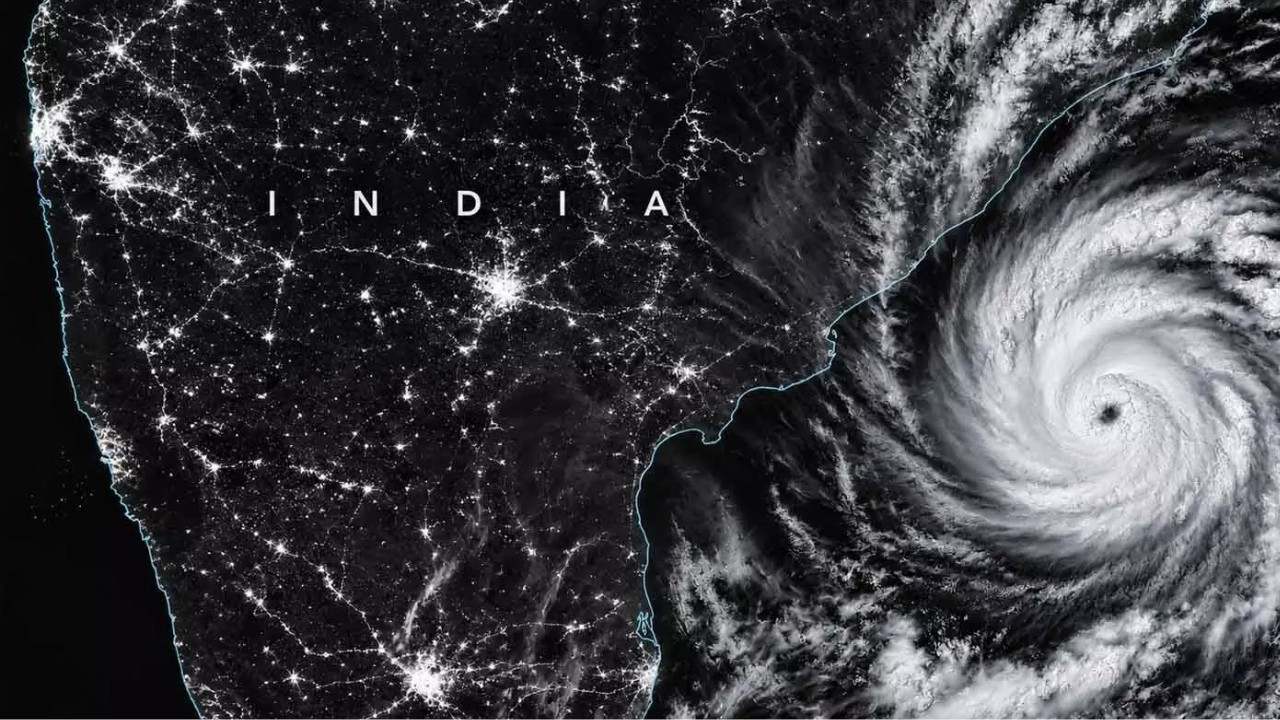
New Delhi: Cyclonic storm has once again increased concern in the Bay of Bengal. Cyclone Murasu has transformed into a severe cyclonic storm and is rapidly moving towards the coastal areas of Andhra Pradesh. The Indian Meteorological Department (IMD) has issued an alert regarding this. According to the Meteorological Department, the storm may hit the southern coast of Andhra Pradesh between midnight on 2 November and morning of 3 November. During this period, the wind speed is expected to be 100 to 110 kilometers per hour and the speed of gusts may reach 120 kilometers per hour.
Where and when will Cyclone Murasu make landfall?
According to the IMD, Cyclone Murasu is active over the west-central and adjoining south-west part of the Bay of Bengal. At 5:30 am on November 2, it was about 200 km east-northeast of Chennai and 210 km east-southeast of Nellore.
The Severe Cyclonic Storm “Murasu” [Pronunciation: Murasu]” over Westcentral & adjoining Southwest Bay of Bengal moved west-northwestwards with a speed of 25 kmph during past 06 hours and lay centered at 0530 hours IST of today, the 02nd November, 2026 over the same region near Latitude 13.9°N and Longitude 81.8°E, about 200 km east-northeast of Chennai (Tamil Nadu), 210 km east-southeast of Nellore (Andhra Pradesh), 270 km south-southeast of Machilipatnam (Andhra Pradesh), 220 km east-southeast of Kavali (Andhra Pradesh), and 260 km southeast of Ongole (Andhra Pradesh). It is very likely to move northwestwards and cross south Andhra Pradesh coast as a Severe Cyclonic Storm with wind speed of 100 to 110 kmph gusting to 120 kmph between Nellore and Narsapur close to Ongole during midnight (2330 Hrs IST) of today, the 02nd November to early hours (0400 Hrs IST) of tomorrow, the 3rd November, 2026.
— India Meteorological Department (@Indiametdept) November 2, 2026
The weather department estimates that the storm will move in a north-westerly direction and cross the south Andhra Pradesh coast around Ongole between Nellore and Narasapur. For this, the possible time has been said to be from 11:30 pm on 2nd November to 4 am on 3rd November.
In which areas will there be heavy rain due to the storm?
Due to the impact of Cyclone Murasu, heavy to very heavy rainfall is likely in the southern and central coastal districts of Andhra Pradesh. There may be extremely heavy rain in some areas on November 2. At the same time, there is an alert of heavy rain in many districts on 3rd and 4th November.
More impact of rain may be seen in districts like Eluru, Krishna, NTR, West Godavari, Guntur and Bapatla. Apart from this, heavy rain is also expected in some parts of Rayalaseema.
Winds will blow at a speed of 120 KM, why is the administration on alert?
According to the Meteorological Department, when the storm hits the coast, winds can blow at a speed of 100 to 110 kilometers per hour. Their gusts can reach up to 120 kilometers per hour. In such a situation, problems like falling of trees, damage to electric poles and waterlogging on the roads may arise.
Andhra Pradesh Chief Minister N. Chandrababu Naidu has instructed the officials to be prepared for relief and rescue operations. Necessary machinery and staff have been asked to be deployed in sensitive areas in advance. Officials have also been instructed to issue information on the situation related to the cyclone every four hours.
What is the preparation of the administration?
The impact of Cyclone Murasu is not limited to Andhra Pradesh only. The administration is on alert in view of heavy rains in southern parts of Odisha also. Preparations have been made to evacuate people living in low-lying areas and hilly areas to safe places.
JCBs, excavators and other heavy machines along with fire teams have been deployed at strategic locations in Rayagada district to immediately clear roads in case they are closed due to heavy rains and storms.
At present, the Meteorological Department is continuously monitoring the direction and speed of the storm. People living in coastal areas have been advised to follow the instructions issued by the administration and not to step out of their homes unnecessarily.