
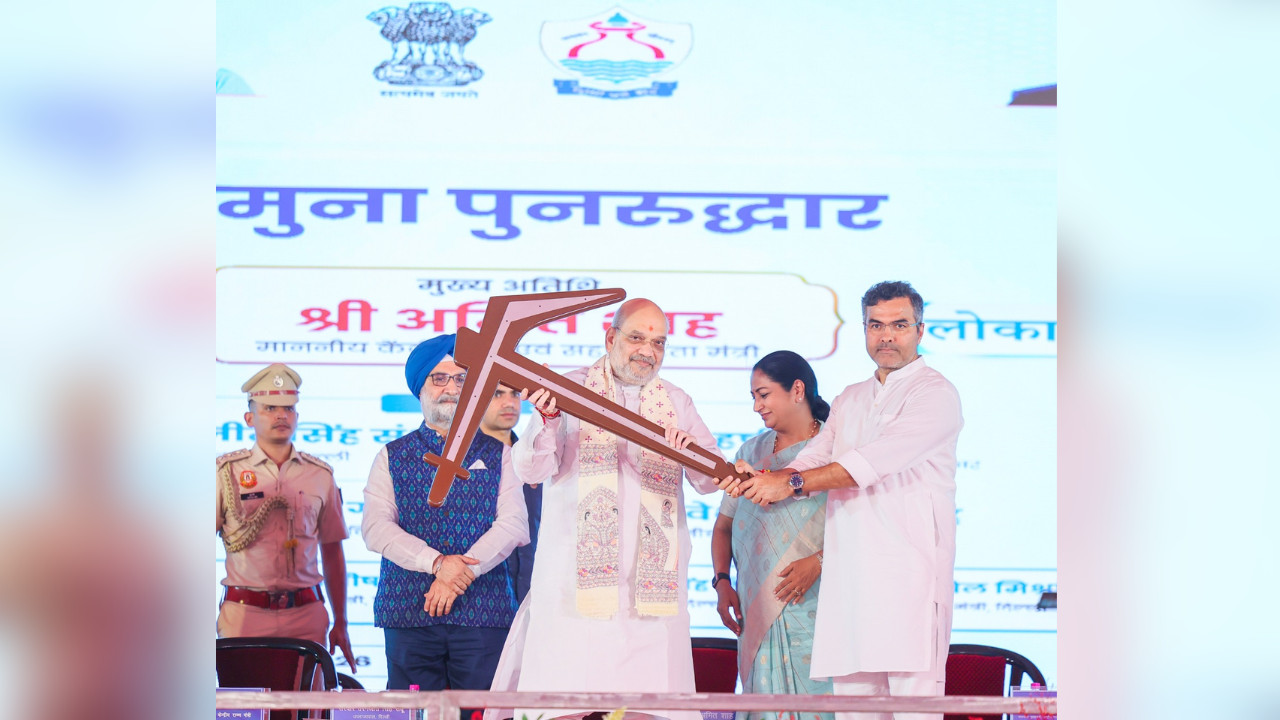
New Delhi: The Centre and the Delhi government have stepped up efforts to clean the Yamuna and improve the capital’s environmental conditions, with Union Home and Cooperation Minister Amit Shah reiterating the target of making the river clean before May 2029.
Speaking at an event on Thursday to inaugurate and lay the foundation stones for projects worth ₹8,941 crore, Shah said a time-bound action plan had been prepared involving Delhi, Haryana and Uttar Pradesh under Prime Minister Narendra Modi’s leadership. The initiative focuses on preventing untreated wastewater from entering the river, strengthening sewer networks and expanding sewage treatment capacity.
Delhi Lieutenant Governor Taranjit Singh Sandhu and Chief Minister Rekha Gupta were among the dignitaries present at the event.
What Do the ₹8,941-Crore Projects Include?
During the programme, 10 schemes were inaugurated and work was launched on 33 additional projects. The initiatives cover upgrades to existing sewage treatment plants, construction of new facilities and pumping stations, household sewer connections, improvements to ageing sewer infrastructure and drainage-related works.
Shah said the government’s objective extends beyond cleaning the Yamuna. It also aims to connect every household in Delhi to the sewer network and improve access to clean drinking water.
He expressed confidence that the projects would produce measurable progress within the announced timeline, although their eventual impact will depend on implementation and the reduction of pollution entering the river.
Government Targets Long-Standing Sources of River Pollution
Shah criticised previous governments, alleging that Delhi’s wastewater and waste generated by dairies had continued to flow into the Yamuna for years. He said the Centre and the governments of Delhi, Haryana and Uttar Pradesh had now developed a coordinated plan to address the problem.
Describing the Yamuna as a lifeline for Delhi, the minister said the government was committed to tackling pollution and improving the capital’s overall environment. The broader vision, he added, includes cleaner streets, reliable access to clean water, the removal of major garbage dumps and a healthier river flowing beyond Delhi towards the Sangam.
How Much Progress Has Been Made on Delhi’s Garbage Dumps?
Shah said the Delhi government, with support from the Centre, had processed 2.17 crore metric tonnes of waste and freed approximately 100 acres of land from accumulated garbage.
According to the minister, the height of the waste mounds at Okhla and Bhalswa had been reduced by around 30 to 40 metres, while the reduction at Ghazipur was approximately 10 to 15 metres.
He said the government planned to transform these sites into green spaces and gardens in the future. Shah also referred to projects such as Asita East, Baansera and Vasudev Ghat as part of wider efforts to make Delhi cleaner, greener and more environmentally sustainable.
Shah Attacks Opposition Over Election-Related Disputes
The event also saw Shah criticise opposition parties over their response to election results. He alleged that parties which lose elections raise questions about electronic voting machines, voter lists and the Election Commission, while accepting institutions when results favour them.
He further claimed that concerns raised over alleged irregularities in electoral rolls were being used to protect the voting rights of infiltrators. These remarks formed part of his broader political criticism of the opposition.
Shah said voters had become more aware of political tactics and argued that protests alone could not overturn a public mandate.
Development and Public Service Key to Winning Trust
Emphasising the importance of public outreach, Shah said political parties must engage with citizens, understand their problems and deliver practical solutions to earn public confidence.
He referred to the public engagement efforts of his party’s workers and Prime Minister Narendra Modi, stressing that governance should be judged by tangible results rather than excuses. He also commented on Punjab, expressing a resolve to eliminate the drug trade in the state.
Implementation Will Determine the 2029 Outcome
The Yamuna restoration programme now faces the challenge of ensuring that untreated sewage no longer enters the river, controlling other pollution sources and completing infrastructure projects on schedule.
The government has set a target of cleaning the Yamuna before May 2029, backed by projects worth thousands of crores. Whether the deadline translates into lasting improvement will ultimately be assessed through the execution of the schemes and measurable changes in the river’s water quality.