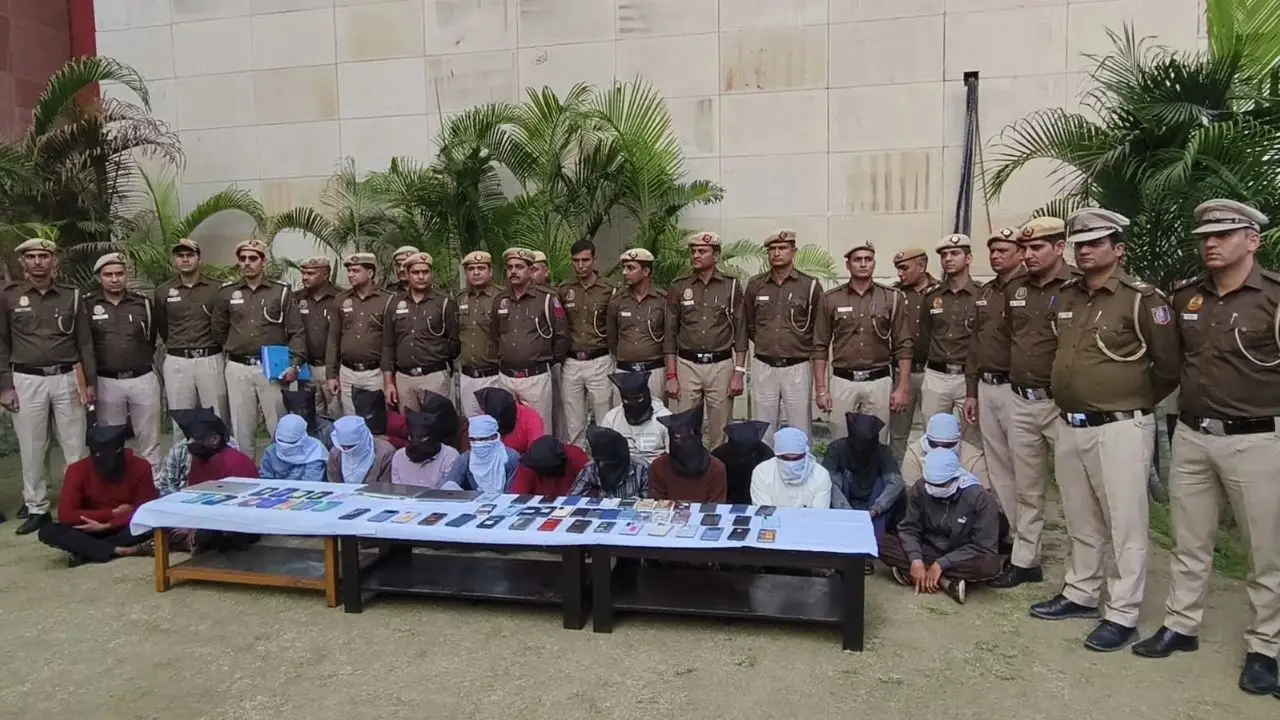
New Delhi: Delhi Police has dismantled an interstate cyber fraud network allegedly operating across Jamtara and several other regions, arresting 22 suspects involved in digital scams targeting people by impersonating bank officials, government representatives and utility service employees. The operation also uncovered individuals allegedly involved in developing malicious APK files and fraud-related panels. Police recovered 63 mobile phones, two laptops, two MacBooks and one tablet from the arrested suspects.
During a press briefing at Delhi Police Headquarters, West District DCP Hreshwar V. Swami said the operation was conducted over five days. Seven special teams comprising 64 personnel carried out coordinated raids at 17 locations across Jharkhand, Bihar, West Bengal and Uttar Pradesh. Searches were conducted in Jamtara, Deoghar, Giridih, Dumka, Jamui, Nawada, Asansol, Kolkata and Gorakhpur.
How Much Money Was Stolen and How Many Victims Were Targeted?
Investigators found that the syndicate had allegedly targeted 22,139 people across the country. A total of 2,080 complaints registered on the National Cyber Crime Reporting Portal were directly linked to the arrested suspects.
According to police, the network is suspected of committing fraud worth more than ₹20 crore. Investigators analysed over 1,300 complaints linked to APK files, conducted forensic examinations of 32 suspicious APK files and examined 56 Telegram profiles associated with the fraud methods.
How Were Victims Trapped Through Malicious APK Files?
The suspects allegedly targeted elderly people by offering assistance with life certificate verification, bank KYC updates, credit card applications, credit limit increases and electricity or gas bill updates through BSES and IGL.
Victims were then persuaded to download APK files sent through WhatsApp. Once installed, these applications allegedly enabled fraudsters to access calls, messages, OTPs, banking information and photo galleries on victims’ phones. The stolen information was subsequently used to gain access to bank accounts and credit cards and siphon off money.
How was the Cyber Fraud Network Operated?
The investigation uncovered an alleged centralised APK-generation panel used to manage the technical infrastructure of the fraud. Access was reportedly provided to distributors through master IDs and passwords, who further supplied separate credentials to sub-distributors on monthly rental arrangements.
These operators could generate fraudulent APK applications with different names and appearances according to their requirements and distribute them to potential victims, allowing the cybercrime network to function through a structured, business-like system.
Where was the Fraud Money Spent?
Police found that the proceeds of cyber fraud were allegedly used to purchase mobile phones, silver coins and gift coupons. Online platforms such as Flipkart Minutes, Swiggy Instamart and BigBasket were reportedly used for these transactions.
Did the Crackdown Reduce APK-Related Cyber Fraud Complaints?
Delhi Police reported a significant decline in complaints involving APK-based fraud following the operation. Between November 2 and 10, a total of 1,406 complaints were recorded, while the figure dropped to 724 between November 11 and 17.
According to police, the decline represents a reduction of more than 50 per cent in reported complaints during the subsequent period.
How Did Seven Special Teams Coordinate the Raids?
The operation was carried out under the guidance of DCP Hreshwar V. Swami, monitored by ACP Operations Rajesh Kumar and led by Cyber Police Station SHO Inspector Vikas Kumar Buladak.
The teams first analysed digital evidence, conducted surveillance of suspected locations and then carried out coordinated raids. With assistance from Jharkhand and Bihar Police, the suspects were apprehended. After completing legal formalities, they were brought to Delhi.
Cases have been registered at the West District Cyber Police Station under e-FIR Nos. 0567/2026 and 0522/2026, invoking various provisions of the Bharatiya Nyaya Sanhita (BNS).
Police are examining the recovered digital devices to identify additional suspects and trace financial transactions linked to the alleged fraud.
The DCP cautioned people against downloading APK files received through unfamiliar WhatsApp messages and urged citizens to verify links or applications claiming to be from banks or government departments before installing them on their phones.