
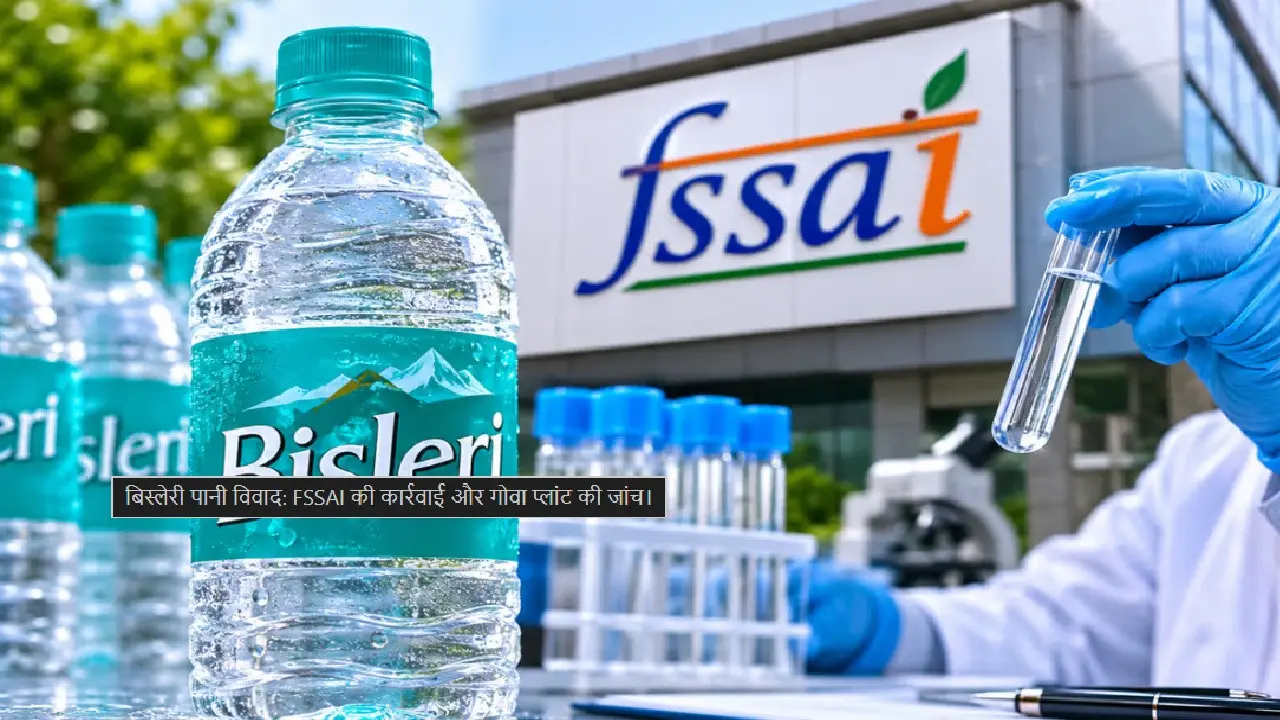
New Delhi: The troubles of the country’s popular packaged drinking water brand Bisleri have increased. The Food Safety and Standards Authority of India (FSSAI) has approved legal action against a company after a sample of its water was found to be unsafe. Initial testing revealed bromate exceeding the prescribed limit and subsequent testing revealed the presence of polynuclear aromatic hydrocarbons (PAHs). These are chemical substances that have been linked to the risk of cancer.
On the other hand, the company has questioned the findings of the test, claiming that during re-testing in an independent laboratory, the amount of bromate was found to be within the prescribed standards. Bisleri has declared its packaged water as safe to drink.
What did FSSAI find in the investigation?
According to the food safety regulator, a regulatory sample of packaged drinking water was taken from the premises of Bisleri International. In initial lab testing, the amount of bromate in it was found to be more than the prescribed limit. On this basis, the sample was declared unsafe under the Food Safety and Standards Act, 2006. After the company’s appeal, the sample was sent to the referral food laboratory. During testing there, the presence of PAHs was revealed and this lab also declared the sample unsafe. FSSAI has given approval to initiate prosecution against the company considering these investigation findings as the basis for violation of law.
What quantity of bromate was found?
According to the company’s statement on November 23, this case pertains to a batch prepared at its manufacturing plant in Goa in September 2025. On September 30, FSSAI had taken six samples of water from there. Bisleri claims that in the initial test, five samples met all the prescribed standards, while in the sixth, the amount of bromate was recorded at 12 micrograms per litre. Its prescribed limit is 10 micrograms per litre. That means bromate in this sample was 20 percent more than the prescribed limit.
What did the company claim in the reinvestigation?
According to Bisleri, it had appealed against the results of the preliminary investigation on 22 November 2025. After this the sample was sent to the referral lab. The company says that the amount of bromate was found within the prescribed limits, but the presence of PAHs was recorded separately in the investigation. Seeing the difference in the test results, the company also got the same sample tested in an independent laboratory approved by FSSAI. According to Bisleri, the quantity of bromate was found within the prescribed limit there too.
What happened after sending the report to FSSAI?
The company says that it had sent the independent lab report along with a formal letter to the Western Regional Office of FSSAI on February 2, 2026. After this he did not receive any further information from the regulator. Bisleri claimed that it did not receive any notice related to the prosecution through email or post and no such notice was found on the FSSAI website either. According to the company, it had considered the matter closed on this basis. However, FSSAI has made public the information about granting sanction for prosecution on the basis of its investigation.
Did the company clarify regarding water quality?
Bisleri has said that safety of drinking water is its priority. According to the company, more than 90 quality checks are conducted in its 10-step manufacturing process. It has said it will continue to cooperate with the regulator and respond to the matter as per due process. The company also reiterated that its packaged drinking water is safe to drink. At present the dispute is regarding the samples of a particular batch and its investigation reports. FSSAI’s action cannot be considered as evidence that all the company’s products are unsafe.
Bisleri International Pvt. Ltd. issues statement after the Food Safety and Standards Authority of India (FSSAI) had sanctioned prosecution against Bisleri International Pvt. Ltd. under the Food Safety and Standards Act, 2006, after a sample of its packaged drinking water failed safety tests. “We are aware of recent media reports that the Food Safety and Standards Authority of India (FSSAI) has issued a notice to Bisleri. The matter dates back approximately 14 months, to a batch produced in September 2025 at Bisleri’s Goa manufacturing facility, one of 143 plants in our network. On 30 September 2025, FSSAI collected six samples from the Goa facility. Initial testing found that five samples met all applicable standards. The sixth recorded a bromate level of 12 micrograms per litre, against the prescribed limit of 10 micrograms per litre. Following Bisleri’s appeal dated 22 November 2025, FSSAI sent that sample to a referral laboratory for retesting. The referral laboratory found bromate of the sample within the prescribed limit and separately flagged polynuclear aromatic hydrocarbons (PAHs) in the sample. The difference between the two results raised questions that Bisleri believed warranted clarification. Bisleri arranged for the same sample to be tested independently at an FSSAI-approved laboratory. That test found bromate within the prescribed limit. We submitted the independent test results to FSSAI’s Western Regional Office with a formal letter dated 2 February 2026. We received no further communication from FSSAI after that submission and understood the matter to be closed. To date, Bisleri has received no notice by email or in hard copy and has been unable to locate the reported notice on FSSAI’s website. Drinking water safety is a priority for Bisleri. We maintain stringent quality controls of over 90 tests across our 10-step manufacturing process and will continue to cooperate with FSSAI to address the matter through the appropriate regulatory process. A trusted brand for years, Bisleri remains safe for consumption…”
— ANI (@ANI) November 23, 2026