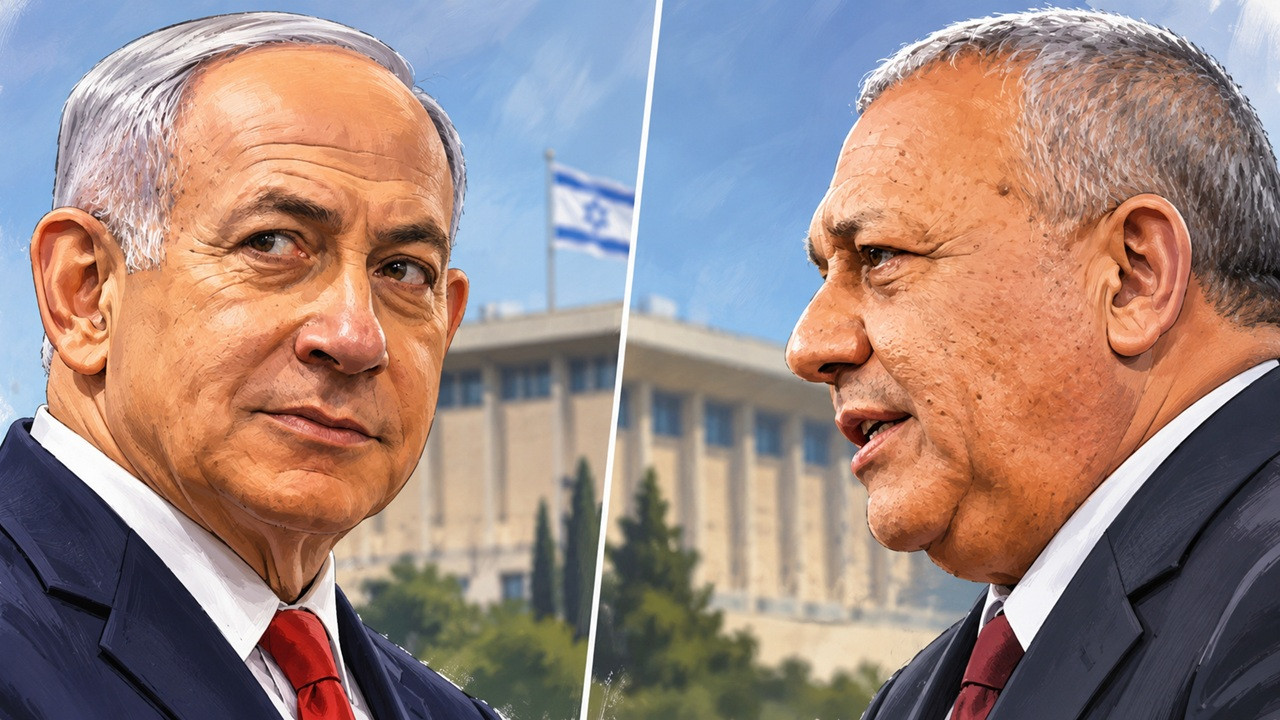
New Delhi: Israeli Prime Minister Benjamin Netanyahu faces the challenge of forming a government. In the recently held parliamentary elections, neither the Netanyahu-led coalition got a clear majority, nor could the opposition parties touch the majority mark. In such a situation, political talks regarding government formation have intensified. Meanwhile, the possible stance of the two major Arab political parties, Joint List and Ra’am, has given a new twist to the political equations. Both parties have a total of 19 seats. If they support the anti-Netanyahu camp led by Gadi Eysenkot, the alliance’s tally could reach 67. However, right now it is being seen only as a possible political equation.
Will the Joint List support anti-Netanyahu parties from outside?
According to ‘The Times of Israel’ report, senior Joint List MP Ahmed Tibi has indicated that his party is ready to provide outside support to the opposition parties to remove Netanyahu from power. However, the party itself does not want to join the government. Tibi, who is considered second in the joint list, said that his party wants to help those trying to oust the current government and form a new government. Linking this change with hope, he expressed his desire to cooperate with opposition parties.
Why the discussion of making Gadi Eisenkot the prime minister?
According to Jafar Farah, who is associated with the Arab political movement, the Joint List and Ra’am may tell Israeli President Isaac Herzog that they are ready to support the opposition camp led by Eysenkot. Under this proposal, former army chief Gadi Eisenkot can be put forward for the post of prime minister. Joint List Chairman Yusuf Jabarin has also said that talks will be held with opposition parties regarding alliance. However, a formal declaration of support from both Arab parties and the final agreement of the alliance is still unclear.
What message did Ahmed Tibi give by giving the example of Yitzhak Rabin?
Ahmed Tibi told Gadi Eysenkot to learn from the political strategy of late Prime Minister Yitzhak Rabin. Rabin took steps towards negotiations with the Palestine Liberation Organization (PLO) and the Oslo Accords in the 1990s. At that time, the support of Arab MPs had strengthened his government at the parliamentary level. Tibi’s statement underlines the role of Arab parties in the current political impasse.
Which alliance got how many seats in the elections?
To form a government in Israel’s 120-member parliament, the Knesset, the support of at least 61 seats is necessary. After the election, the Netanyahu-led coalition got 53 seats, while the opposition camp led by Gadi Eysenkot has 48 seats. Joint List and Raam together have secured 19 seats. In this way, if the opposition camp gets the support of both the Arab parties, the total number can be 67.
Will the figure of 67 seats decide Netanyahu’s departure?
In terms of parliamentary mathematics, adding 48 and 19 seats gives the opposition camp the majority figure, but government formation is not so easy. Some major parties in the opposition coalition have objected to the support of Arab parties. Some parties, including Eysenkot’s party, had already expressed disagreement with Arab parties about government formation. Therefore, mere arithmetic of seats does not guarantee government formation. Only the talks and consensus among the political parties with President Isaac Herzog will decide whether a new government will be formed in place of Netanyahu or not.