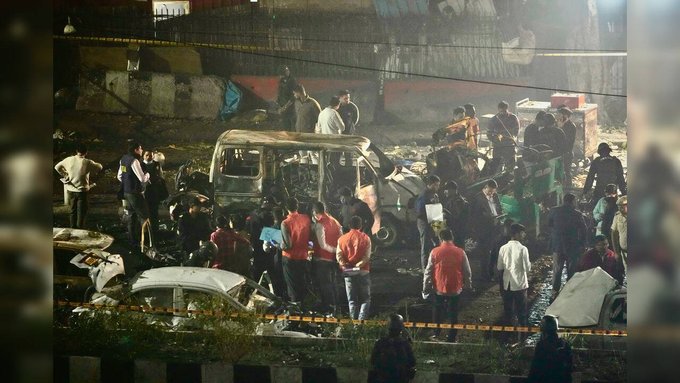
New Delhi: An Al-Qaeda-linked organization was involved in the November 2025 blast near Delhi’s Red Fort that killed 11, according to the report by the United Nations Security Council (UNSC). The blast, which occurred near the Red Fort on the evening of November 10, 2025, killed 11 people and injured several others.
What is there in the report?
According to the report, Al Qaeda in the Indian Subcontinent (AQIS) carried out the blast. It states that AQIS now operates through small cells and has established its own logistics and financial network.
“Al-Qaeda in the Indian Subcontinent (AQIS, not listed) continued to evolve from a fragmented group into a regional terrorist entity; it established logistics and financial networks, working in decentralised small, scattered cells instead of large units. The attack in November 2025 on the Red Fort in Delhi was initially attributed to AQIS. There was some concern about AQIS trying to exploit Bangladesh to establish cells there,” the report said.
Earlier, in the UNSC report, a member state had blamed Jaish-e-Mohammed (JeM) for the attack. This means that two different terrorist organizations have been named in two consecutive UN Security Council reports regarding this attack. However, the NIA chargesheet claimed that the accused were linked to AQIS.
Is AQIS establishing terrorist cells in Bangladesh?
The report, which was issued on August 10 by the UNSC’s Analytical Support and Sanctions Monitoring Team, says that AQIS has transformed into a regional terrorist group from what used to be an unorganized small terrorist group.
The group has created its own logistical and financial structure, and is now operating through individual cells instead of large groups.
It is also noted in the report that AQIS is trying to create terrorist cells in Bangladesh, which is a cause of great concern.
What about chemical and biological weapons?
According to the report, Al-Qaeda and ISIL/Daesh have been trying to create chemical and biological weapons that could destroy masses, but until now, they have been unable to do so due to the difficulty of producing such weapons.
As per the report, procedures and knowledge about manufacturing such toxic chemicals are being shared through the internet among such terrorist groups. In February, ISIL’s English language magazine titled “Invade” issued the method to prepare toxic chemicals including botulinum toxin and cyanide. According to the report, ISIL-K has circulated information regarding the development of toxic chemical “ricin” within their group over the past year.
Why is UNSC giving Delhi blast report?
United Nations Security Council (UNSC) oversees the activities of the terrorist organizations. A team responsible for reporting is tasked with the work of compiling reports and collecting information about the terrorist organizations’ networks, funding, and activities.
The UN Security Council’s 1267 Sanctions Committee collaborates with organizations linked to Al-Qaeda and ISIS. The monitoring team evaluates the danger associated with terrorist organizations through information received from different countries. In addition, sanctions like travel bans, weapons embargoes, and asset freezes are imposed by UNSC on such organizations and their affiliates.
The UNSC plays an important role in the Red Fort blast as the report of its monitoring team has connected the incident with AQIS.
When did the blast happen?
A car bomb explosion took place on November 10, 2025, near the Red Fort in Delhi. It led to the death of 11 people and left some others wounded. Investigations into the incident found out that the driver of the car, Dr. Umar Un Nabi, was the prime suspect of the incident in which he himself lost his life. The investigation conducted by the NIA found out that the accused persons in this case were associated with a network and its module of Al-Qaeda.