
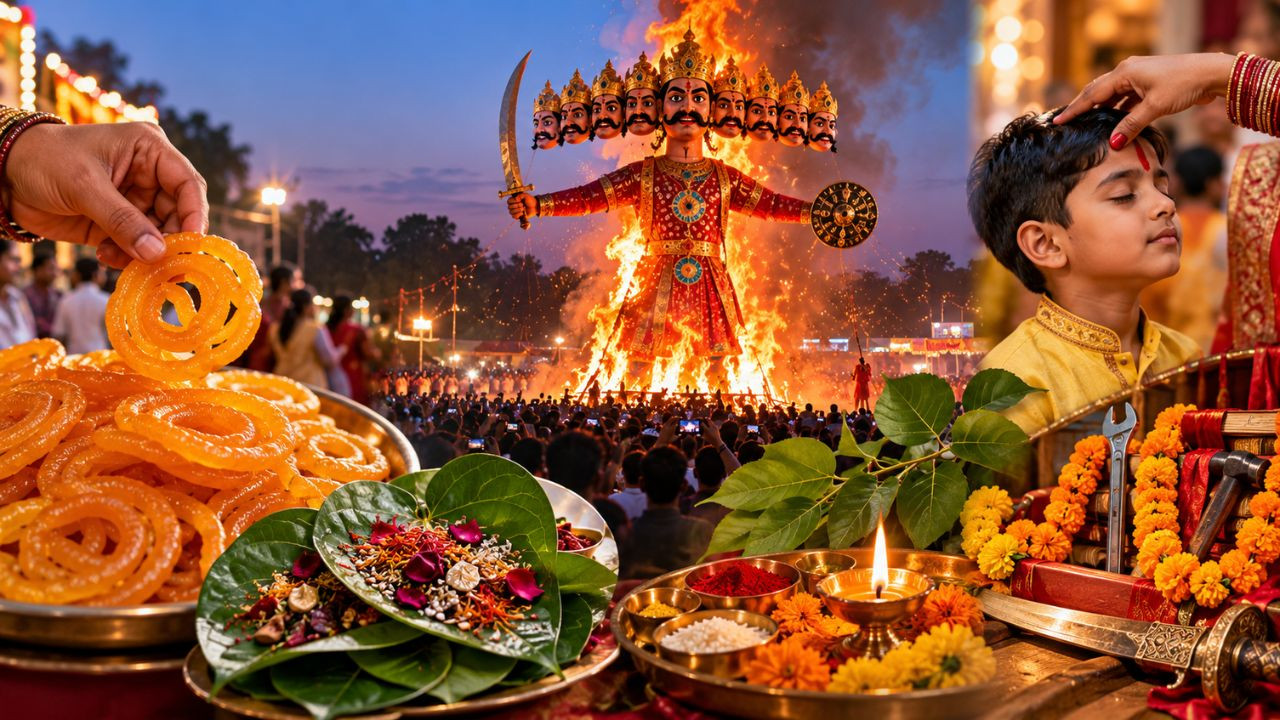
New Delhi: Dussehra is one of the major festivals of Hinduism. This festival is considered a symbol of the victory of good over evil and religion over unrighteousness. According to Ramayana, Lord Shri Ram had freed Mother Sita by killing Ravana, the king of Lanka, on this day. Dussehra is celebrated across the country to celebrate this victory. At many places, effigies of Ravana, Kumbhakarna and Meghnad are burnt, while at some places weapon worship and special religious rituals take place. But do you know that in many parts of India there is a tradition of eating Jalebi and Paan after Ravana Dahan on Dussehra? Let us know the beliefs behind these customs.
Why do we eat Jalebi after Ravana Dahan on Dussehra?
In many areas of North India, there is a trend of eating Jalebi after Ravana Dahan on the day of Dussehra. This tradition is associated with the happiness and sweetness of the festival. According to religious beliefs, Lord Shri Ram liked a sweet called Shashkuli, which is associated with Jalebi. However, there are different opinions regarding the historical basis of this belief.
Eating Jalebi on Dussehra is also considered a way to celebrate victory. People distribute sweets with family and friends and share the joy of the festival. The tradition of considering the sweetness of Jalebi as a symbol of happiness, prosperity and well-being in life is also prevalent.
Why is the tradition of eating paan special?
On the occasion of Dussehra, the tradition of eating paan and feeding each other is also followed in many places. In Hindu religion, betel leaves are considered to have special importance during worship and religious rituals. These are considered symbols of auspiciousness and auspiciousness. It is believed that eating paan and feeding it to others on Dussehra is a way of sharing the joy of victory. In some areas, people wish each other by feeding them betel leaves. It is also seen as associated with love, respect and mutual reconciliation. However, this tradition is not uniform across the country and local beliefs behind it are prevalent in different regions.
Why are Shami leaves distributed considering them as gold on Dussehra?
In some parts of the country including Maharashtra, there is a tradition of giving Shami leaves to each other on the day of Vijayadashami. These are considered symbolically gold. People wish happiness, prosperity and success by giving Shami leaves to their family, friends and acquaintances. The message of this tradition is that on the occasion of the festival, people should wish each other happiness and progress in life. Distributing Shami leaves is believed to be associated with auspicious beginnings and wishes for prosperity.
What is the importance of the tradition of applying tilak?
On Vijayadashami, the elders of the family bless the younger ones by applying tilak on their forehead. The method of vaccination may be different in different places. In some traditions, curd, rice and vermilion are used, while in many regions tilak is applied with roli and akshat.
This ritual is associated with the wish for happiness, prosperity, success and long life. Nepal also has a special tradition of vaccination on the occasion of Dussehra. During this time, family members bless each other and celebrate the festival.
Why is Shastra Puja performed on Vijayadashami?
The tradition of weapon worship on the day of Dussehra is also quite old. In many places people worship weapons, tools and equipment used in work. In some parts of South India, books, musical instruments and tools are also honoured on this occasion. Weapon worship is considered a symbol of respect for power, duty and security. At the same time, the worship of tools and books shows the importance of hard work, knowledge and livelihood. In this way, Vijayadashami is not only a religious festival but also gives the message of adopting responsibility, hard work and positivity in life.
Overall, these Dussehra traditions reflect the cultural diversity of India. At some places victory is celebrated with Jalebi and Paan, while at other places prosperity is wished by distributing Shami leaves. The essence of all these rituals is to share happiness, strengthen relationships and celebrate the victory of goodness.