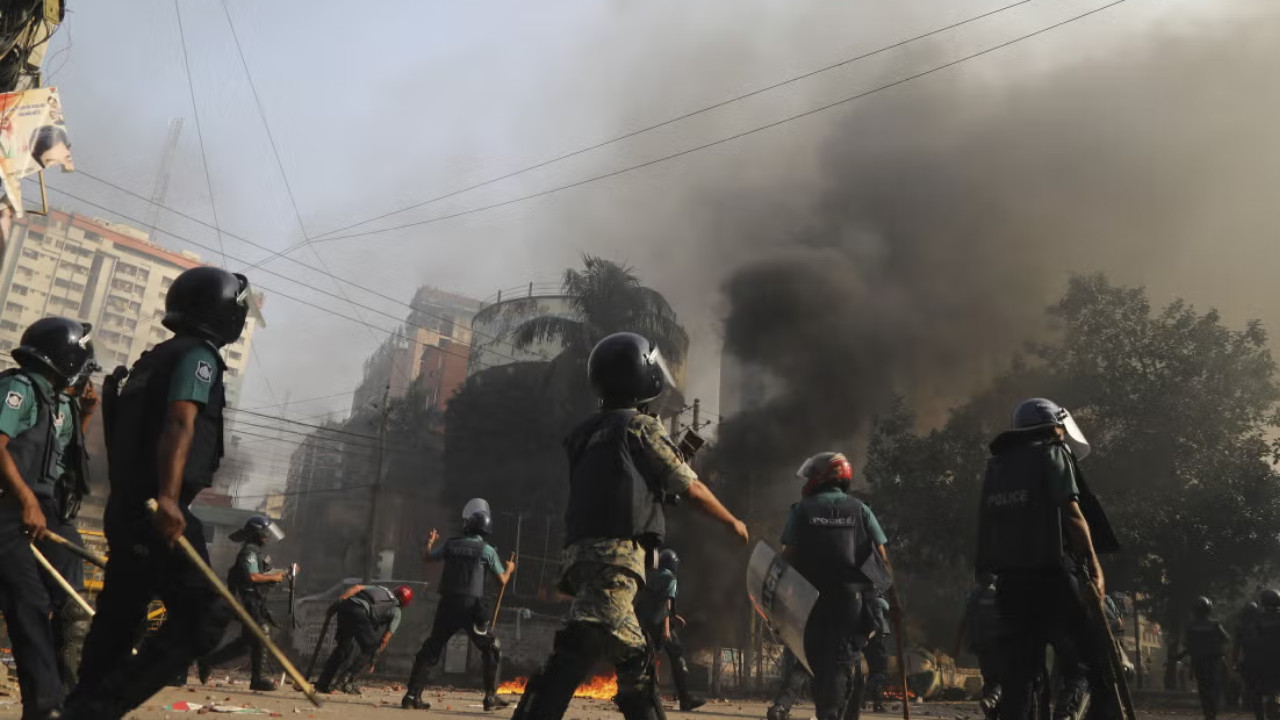
Dhaka: Tension seems to be increasing once again in the politics of Bangladesh. Amid talks of the possible return of former Prime Minister Sheikh Hasina, violence, labour protests and clashes between political parties in the country have worsened the situation. Prime Minister Tariq Rehman faces a big challenge of maintaining law and order as well as dealing with political instability. Meanwhile, he has pointed towards India regarding the increasing violence in the country.
On Friday, Tariq Rehman hinted at India’s role behind the violence. His statement came the day after his meeting with Jamaat-e-Islami chief and opposition leader Shafiqur Rehman. Meanwhile, the houses of leaders and workers associated with Awami League are being targeted in Bangladesh. According to reports, incidents of arson in more than 30 houses have been reported in many areas.
Why is tension increasing between Jamaat and BNP?
After the ban on Awami League in Bangladesh, political equations are changing rapidly. According to media reports, the meeting between Prime Minister Tariq Rehman and Jamaat chief Shafiqur Rehman is being seen as an attempt at political dialogue between the two parties. It is being said that the Jamaat chief had advised the Prime Minister to talk to all political parties to end fascism.
However, in the absence of Awami League, differences between BNP and Jamaat-e-Islami are continuously increasing. The ‘July National Charter’ was approved by the public in a referendum held along with the general elections in February 2026. Now BNP wants to implement these reforms through Parliament, while Jamaat is demanding the formation of a separate Constitution Reform Council.
Both political parties are also accusing each other of making a behind-the-scenes deal with the banned Awami League. At the same time, BNP is trying to strengthen its secular image and gain international support.
How many houses and shops were burnt during the violence in Bangladesh?
The effect of political tussle is now visible on the streets also. According to reports by ‘Dhaka Tribune’ and ‘BDNews 24’, violence broke out in several areas after the killing of three BNP workers and a bus conductor. After this, more than 50 houses and shops belonging to Awami League leaders and workers were set on fire in Kalia Upazila of Narel district.
There have been reports of clashes between the two sides in Pabna district also. These continuous incidents have raised questions on the security system of the country. Minister of State for External Affairs Humayun Kabir has described Awami League as a terrorist organisation and said that those who incite violence while living abroad will be brought back from India under the extradition treaty.
Why is business being affected by workers’ protest?
Labour dissatisfaction, along with political violence in Bangladesh is also increasing the problems of the government. According to the report of ‘The Daily Star’, there was a clash between garment factory workers and the police over the demand of minimum wages in Ashulia. After this incident, dozens of textile factories had to be closed.
The garment industry is an important part of the economy of Bangladesh. In such a situation, there is a possibility of business being affected due to workers’ protest and closure of factories. The government is now faced with the challenge of meeting the demands of the workers and maintaining normal industrial activities.
Why are questions being raised about UN peacekeeping missions?
Bangladesh’s troubles are not limited to domestic politics and violence. The country is also facing international criticism over the issue of sending officials facing allegations of human rights violations to UN peacekeeping missions.
On one hand the government is trying to maintain political stability, on the other hand violence, the labour movement and questions arising at the international level have increased its concerns. In such a situation, it has become a big challenge for Prime Minister Tariq Rehman to restore peace in the country and establish trust among political parties.