
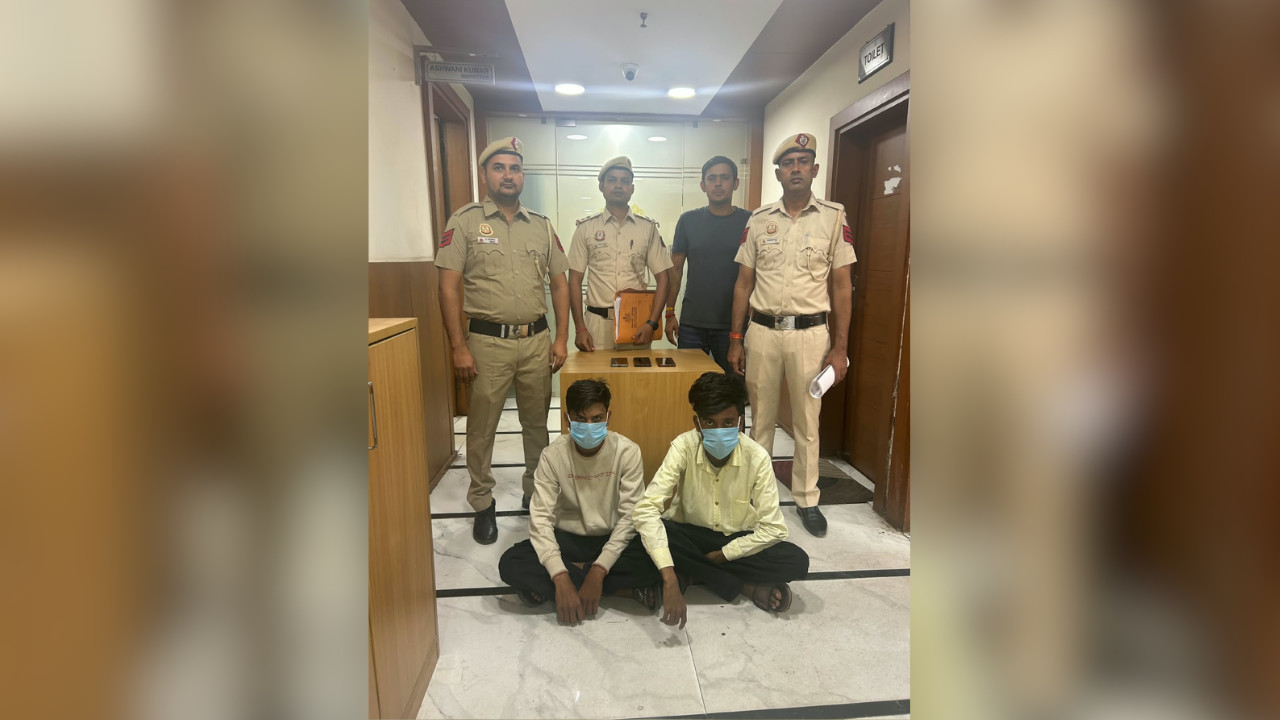
New Delhi: The Shahdara District Police have arrested two men from Jharkhand for their alleged involvement in a cyber fraud operation in which criminals impersonated bank officials to obtain confidential credit card details and make unauthorised online purchases. The arrests followed a four-day operation in the Jharia area of Dhanbad district, with investigators suspecting that more than 50 people may have been targeted.
The accused have been identified as Aftab Ansari, 24, and Abdul Majid, 23, both residents of Borwa village in Jharkhand’s Jamtara district. According to police, Aftab is a BTech graduate.
Shahdara DCP Rajendra Prasad Meena said preliminary investigations suggest that the accused allegedly worked with associates to pose as bank representatives and deceive credit card users. They reportedly offered assistance with know-your-customer (KYC) updates to obtain sensitive information, including card numbers and CVV details. The suspects allegedly used screen-sharing techniques to access one-time passwords (OTPs) and carry out unauthorised online transactions.
The actual number of victims and the total financial loss are yet to be established, as the investigation is continuing.
A Mobile Phone Delivery Led Investigators to Jharkhand
The investigation began after a complaint from Taranjit Singh, who alleged that unidentified individuals contacted him by phone and WhatsApp while posing as HDFC Bank officials. Under the pretext of updating his credit card KYC details, they allegedly obtained confidential information and subsequently carried out unauthorised transactions using his card.
Investigators traced one disputed transaction to the purchase of a Samsung Galaxy S26 Ultra through JioMart. The handset was valued at Rs 1,39,999 and delivered to Jharia in Dhanbad district, providing police with a crucial lead outside Delhi.
An e-FIR, numbered 292/2026, was registered at Cyber Police Station Shahdara on September 23, 2026, under Section 318(4) of the Bharatiya Nyaya Sanhita (BNS).
Four-Day Operation Ends in Two Arrests
After analysing technical evidence and information obtained from relevant service providers, the police team launched an operation in Jharkhand. Investigators used technical surveillance, local intelligence and field verification to identify the suspects.
According to police, the team devised a plan with assistance from a delivery worker to arrange a controlled delivery of a mobile phone at a location previously used by the suspects. When the two men allegedly arrived to collect the package, the waiting police personnel apprehended them.
Three mobile phones were recovered during the operation—two from Aftab Ansari and one from Abdul Majid. Police said the devices contained WhatsApp conversations and other digital material potentially connected to the case. The contents are yet to undergo detailed examination and forensic analysis.
How Did the Alleged Credit Card Fraud Work?
Investigators suspect that the operation relied on social media advertisements, fake banking assistance and the misuse of confidential information.
According to police, the accused and their associates allegedly posted advertisements, particularly on Facebook, offering help with credit card KYC updates. People responding to these advertisements were reportedly asked to fill out online forms, allowing the suspects to collect personal and contact details.
The suspects would then allegedly call the individuals while posing as bank officials and offer to complete the verification process through video calls. Victims were reportedly persuaded to display their credit card details on camera and share their mobile screens, enabling the accused to obtain OTPs.
The information was allegedly used to order expensive smartphones through online shopping platforms such as JioMart and Flipkart. Police said deliveries were arranged at locations across Jharkhand and West Bengal, making it more difficult to trace the people involved.
The handsets were then allegedly sold in local markets at comparatively lower prices. Sealed packaging and purchase invoices reportedly helped make the transactions appear similar to legitimate retail sales.
BTech Graduate Under Investigation
Police are examining Aftab Ansari’s technical background, the recovered devices and the digital conversations found on them. Investigators are also attempting to identify possible associates and establish the accused persons’ alleged roles within the wider network.
The role of Abdul Majid is also being investigated. Officers are working to determine how responsibilities were divided, where the proceeds of the alleged fraud went and whether the accused were linked to other cybercrime cases.
Special Cyber Police Team Conducts the Operation
The operation was carried out by a team from Cyber Police Station Shahdara comprising Sub-Inspector Shyam Bihari Sharan, Sub-Inspector Vivek Yadav, Head Constable Sachin Shalot, Head Constable Kapil, Head Constable Mohammad Mohsin and Head Constable Ravinder Dutt.
The operation was led by Inspector Vijay Kumar, Station House Officer of Cyber Police Station Shahdara, under the supervision of the Assistant Commissioner of Police, Operations, Shahdara.
Investigation Continues Into Wider Network
Police are continuing efforts to recover the Samsung handset purchased through the disputed transaction, identify other suspected members of the network and trace the alleged proceeds of the fraud.
Investigators are also examining whether the accused may be connected to other cases involving similar methods. The claim that more than 50 people were targeted remains preliminary, and the final number of victims and the total financial loss will be determined as the investigation progresses.
DCP Issues Cyber Safety Advisory
DCP Rajendra Prasad Meena urged citizens to remain cautious when receiving calls or video calls from unknown individuals claiming to represent banks or offering assistance with KYC updates and credit card verification.
He advised people never to share their credit or debit card numbers, CVV details, OTPs, PINs or other confidential banking information with strangers. Citizens were also cautioned against sharing their mobile screens at the request of unknown callers or clicking on suspicious advertisements and links.
People should verify banking-related requests through official bank websites or customer care numbers. Anyone who falls victim to cyber fraud should immediately contact the national cybercrime helpline at 1930 or file a complaint through the National Cyber Crime Reporting Portal.