
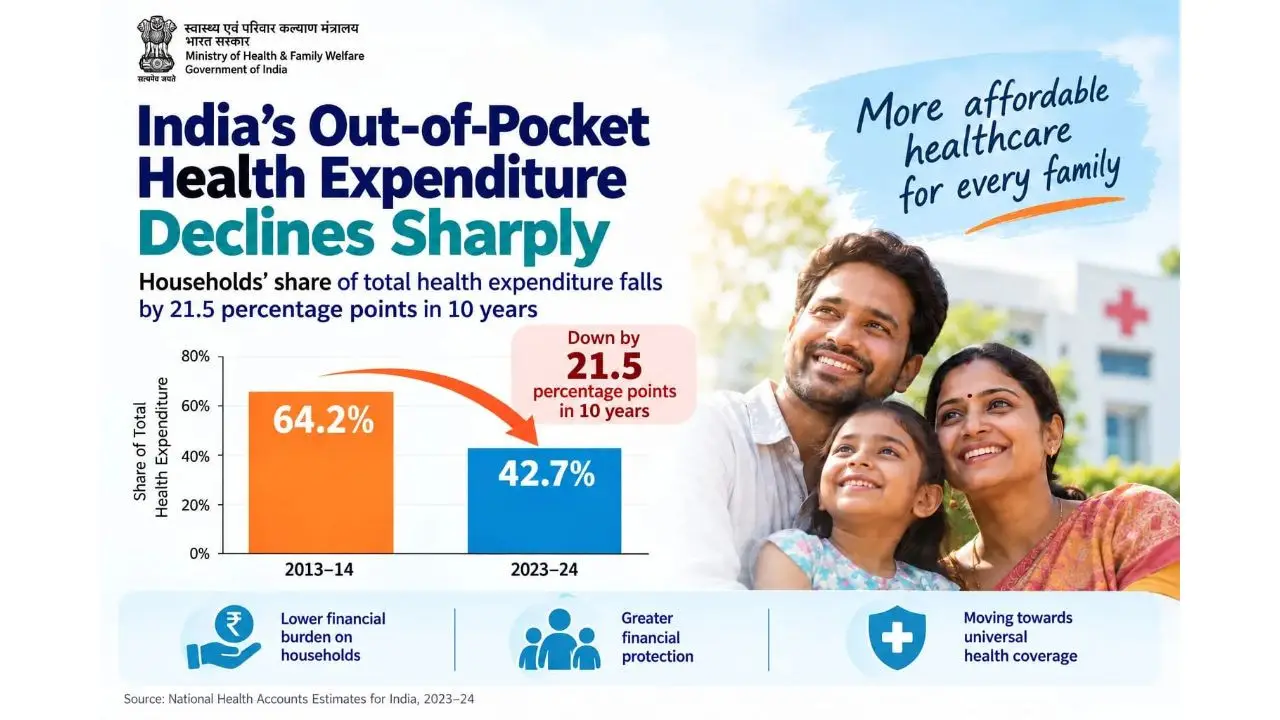
New Delhi: Healthcare in India is becoming more financially accessible, with government spending on health services rising more than threefold over the past decade. According to the National Health Accounts Estimates 2023-24 released by the Central Government, public expenditure on healthcare increased from Rs 1.30 lakh crore to Rs 4.14 lakh crore during this period. Meanwhile, the share of medical expenses paid directly by households has declined significantly, indicating a reduction in the financial burden on families.
A report released by the Union Ministry of Health and Family Welfare revealed that the share of out-of-pocket expenditure (OOPE) in total health spending fell by 21.5 percentage points compared with 2013-14. The figure declined from 64.2 per cent to 42.7 per cent in 2023-24, compared with 43.4 per cent recorded in 2022-23.
How has government spending improved healthcare affordability?
Government expenditure on healthcare has also increased on a per-capita basis. Public health spending per person rose from Rs 1,042 to Rs 2,959 over the decade, reflecting a substantial expansion in government investment.
The government allocated Rs 1.53 lakh crore towards primary healthcare services, highlighting the growing emphasis on strengthening healthcare facilities at the grassroots level. Additionally, the contribution of social security expenditure in healthcare increased from 6 per cent to 11 per cent.
Government schemes strengthen financial protection
Several government initiatives have contributed to improving healthcare access and reducing the financial pressure on households. These include Ayushman Bharat Pradhan Mantri Jan Arogya Yojana, Ayushman Arogya Mandirs, Pradhan Mantri Bhartiya Janaushadhi Kendras, free medicine and diagnostic services, and the Pradhan Mantri National Dialysis Programme.
The contribution of private health insurance to total health expenditure has also increased, rising from 3.4 per cent to 10.2 per cent.
The latest estimates underline the expansion of public investment in healthcare and the growing role of financial protection mechanisms. The decline in direct household spending indicates progress towards making medical treatment more affordable and accessible across the country.