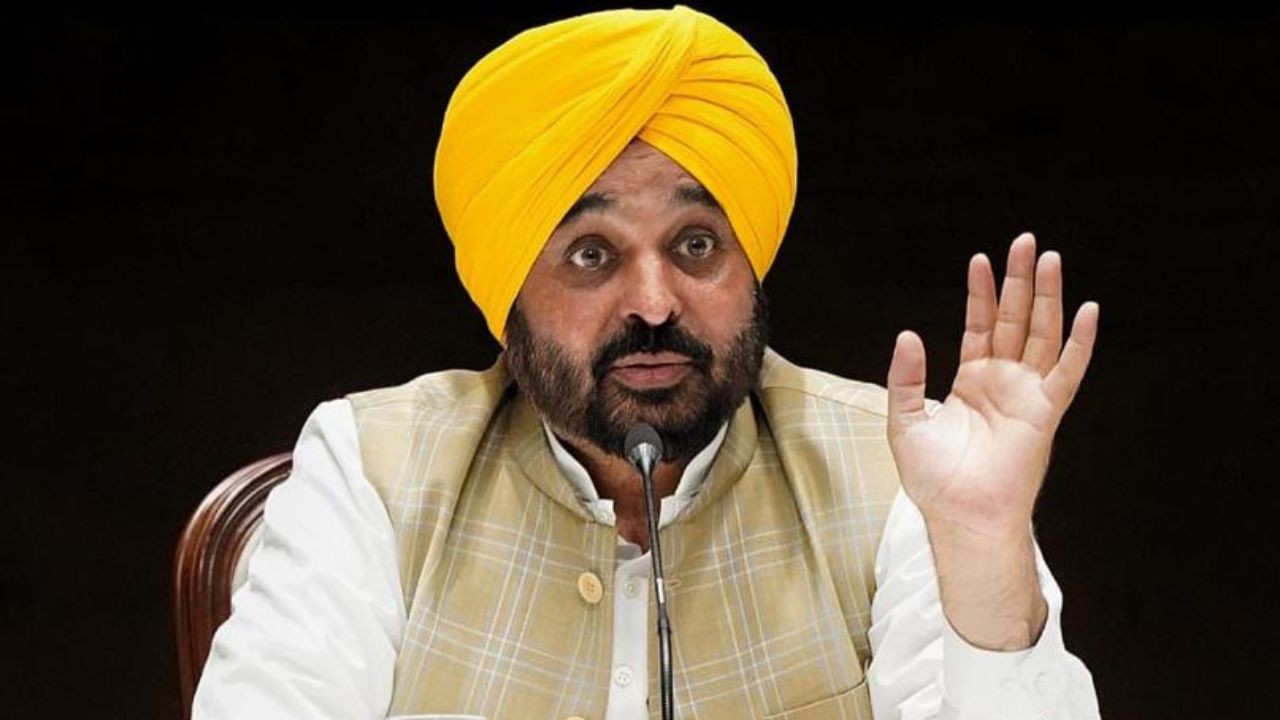
Chandigarh: A new opinion poll by SCORE Intelligence, conducted ahead of the 2027 Punjab Assembly elections, predicts a landslide victory for the Aam Aadmi Party (AAP), led by Chief Minister Bhagwant Singh Mann. Despite anti-incumbency sentiment and persistent criticism from the opposition, the survey estimates that the Aam Aadmi Party could secure between 69 and 82 seats in the 117-member Legislative Assembly. Since a simple majority requires 59 seats, even the lower end of the survey’s projection exceeds the majority mark by 10 seats.
The survey, which gathered the opinions of 28,347 individuals between September 13 and October 14, 2026, projects the following seat ranges: 17–34 for the Congress, 4–12 for the BJP, 2–6 for the Shiromani Akali Dal, and 2–6 for ‘Waris Punjab De’. One seat is attributed to ‘others’, while six seats are identified as having a close or tied contest. As these are estimated ranges, the total number of seats cannot be determined by simply adding up the maximum figures from each category.
Although the survey estimates that the Aam Aadmi Party’s vote share will decline from 42.01% in 2022 to 38%, the projected seat count remains well above the majority mark. Furthermore, the data regarding the preferred candidate for Chief Minister is significant; 39.36% of respondents expressed a preference for Bhagwant Singh Mann as the next Chief Minister. Meanwhile, 15.61% favored the Congress party’s Charanjit Singh Channi, and 10.42% preferred Sukhbir Singh Badal of the Shiromani Akali Dal. A notable margin is observed between Bhagwant Mann and the two key opposition figures.
Public sentiment regarding the government’s performance also forms a crucial part of the survey. In Punjab, 57.70% of respondents praised the performance of the Mann-led government—with 43.07% rating its work as “very good” and 14.63% as “good.” Conversely, 20.18% described the performance as “average,” while 22.12% expressed dissatisfaction. These figures clearly indicate that those who praised the government’0s work significantly outnumber those who are dissatisfied. Positive feedback regarding the government’s performance was also recorded across all three major regions of Punjab: Majha, Malwa, and Doaba. In Doaba, 60.31% of people praised the government’s performance, while 18% expressed dissatisfaction. In Majha, 58.37% of the public expressed satisfaction, with only 22% offering a negative response. Similarly, in Malwa, 56.59% of respondents viewed the government’s performance positively, while 22% viewed it negatively.
The survey also revealed significant data regarding the benefits of government schemes. In the Doaba region, 65% of respondents reported receiving benefits from the ‘Mawan Dhiyan Satkar’ scheme—an initiative providing financial assistance to women—while 64.92% mentioned receiving free electricity, and 36.65% reported benefiting from the ration (flour and pulses) scheme. In the Majha region, 67.11% of respondents reported receiving benefits from the women’s assistance scheme, and 65.07% from the free electricity scheme; additionally, 17.05% of respondents in this region noted that they had benefited from ‘Aam Aadmi Clinics.’ In the Malwa region, 52.40% of respondents reported receiving benefits from the women’s assistance scheme, 44.96% from the ration scheme, and 39.28% from free electricity. These region-specific figures provide an insight into the reach of government schemes and the experiences of the public. However, receiving benefits from these schemes should not be equated with a preference for voting for any particular political party.
Amidst the ongoing political debate regarding law and order in Punjab, 47.11% of the people surveyed expressed satisfaction. Furthermore, 10.83% were found to be partially satisfied, bringing the combined total of those who are either fully or partially satisfied to 57.94%. Conversely, 36% of the respondents expressed dissatisfaction with the state of law and order, while 5.51% did not offer a clear opinion.
In the survey, 48.07% of respondents expressed satisfaction with the performance of their local MLAs, while 35.14% expressed dissatisfaction. Additionally, 9.82% of respondents rated their MLA’s performance as average, and 6.98% did not offer a clear opinion. The survey data presents varied implications for the opposition parties. The Congress party’s vote share is projected to rise from 22.98% in 2022 to approximately 24%, though its seat tally is estimated to fall within a range of 17 to 34. Questions that periodically arise regarding leadership and organizational cohesion within the Punjab Congress are significant in the context of election preparations.
Meanwhile, the BJP’s vote share is projected to increase from 6.60% in 2022 to 14%. The Shiromani Akali Dal’s vote share is estimated to decline from 18.38% to 12.50%. The survey also projects an 8.50% vote share for ‘Waris Punjab De’. These figures suggest that the distribution of votes among various parties in Punjab could shift compared to 2022. There remains ample scope for the political landscape in Punjab to evolve before the next assembly elections. Currently, this survey by SCORE indicates that the Aam Aadmi Party is projected to secure a number of seats exceeding the majority mark. Key findings from this pre-election study include preferences for the Chief Ministerial candidate, ratings of government performance, and region-specific feedback. Furthermore, data concerning potential declines in vote share and dissatisfaction regarding various issues are also noteworthy.