
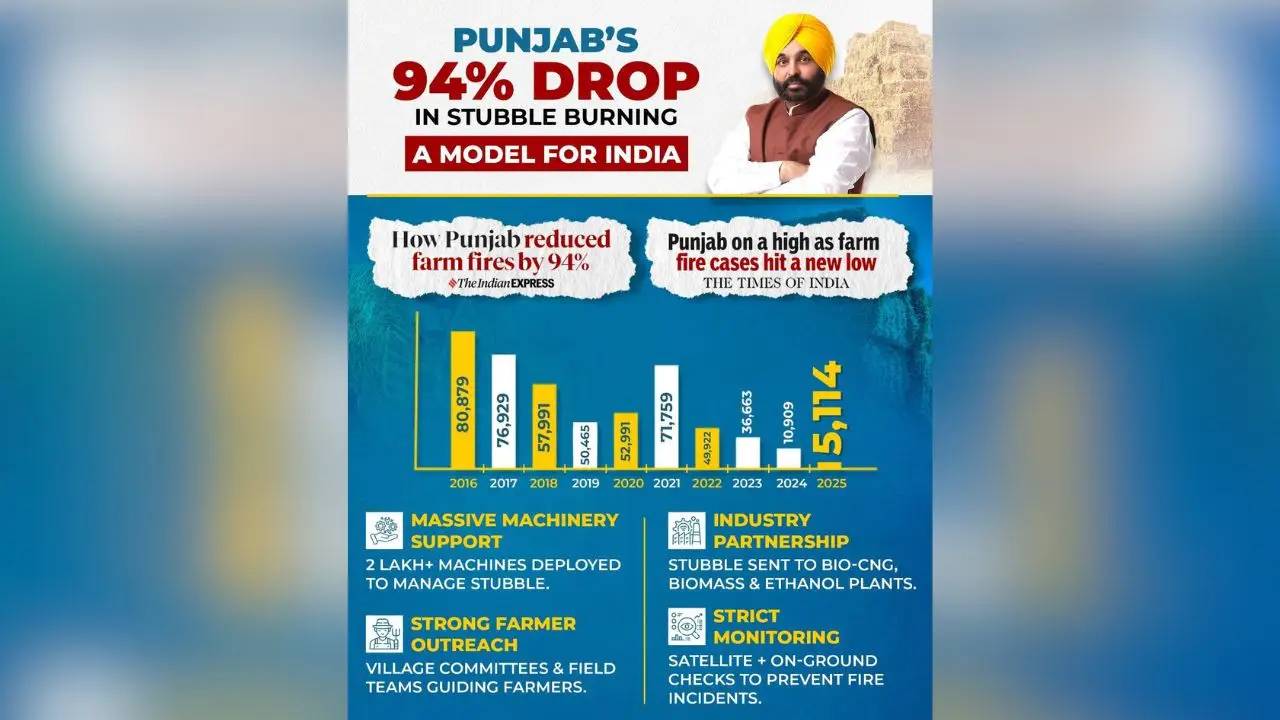
Punjab announced with pride that the state has recorded a 94% reduction in stubble burning, marking one of India’s biggest environmental victories. The success is being seen as a national model of change. Under Chief Minister Bhagwant Mann, the government adopted a farmer-first and science-driven policy approach. This shifted Punjab from being a major pollution contributor to a leading reform state. In 2016, Punjab reported over 80,000 farm-fire cases. Today, the number has dropped to just 5,114. This dramatic fall shows the power of sustained, long-term policy backed by farmers.
Why the Centre Approved the Punjab Model for India
The Centre’s Agriculture Minister Shivraj Singh Chouhan publicly endorsed the Punjab Model. He said India needs to replicate this success nationwide. The model proved that strict punishment alone cannot solve stubble burning. Instead, support, partnership and solutions delivered real impact. Punjab’s strategy balanced environmental goals with farmer welfare. The campaign improved soil health, reduced air pollution and ensured stable incomes. Punjab has shown that a cooperative model can outperform enforcement-heavy frameworks.
How Massive Machine Deployment Changed the Game
Punjab’s biggest transformation came through the CRM programme launched in 2018-19. The state distributed lakhs of advanced crop-residue machines. These included Super Seeders, Happy Seeders, Mulchers, MB Ploughs and Balers. Subsidies were raised to 80% for small farmers. Machine numbers grew from 25,000 in 2018 to more than 1.48 lakh in 2025. Farmers rapidly adopted Super Seeders once availability improved. These machines allowed residue to be mixed back into the soil. This helped wheat sowing and reduced the need to burn crop waste.
Industry Partnerships Turned Waste Into Revenue
Punjab expanded a large network of biomass power plants, paper mills and bio-CNG units. These industries now directly buy stubble from farmers. This created a new income source while eliminating residue from fields. Last year, industries reused over 2.76 million tonnes of stubble. This year, the number touched an unprecedented 7.5 million tonnes. The circular economy model has now become a backbone of Punjab’s residue-management success. It ensures environmental benefits and financial gains to farmers simultaneously.
Awareness Campaigns Changed Mindsets at the Village Level
Punjab formed residue-management committees in nearly every village. Agriculture officials, district teams and volunteers conducted door-to-door outreach. Farmers were taught about long-term soil damage caused by burning. They also learned how residue retention increases productivity. This awareness created a major shift in mindset. Farmer unions, once supporters of burning, have become silent in recent years. The state continued constant communication through schools, colleges and local institutions. This built trust and encouraged farmers to adopt cleaner practices.
Monitoring Was Strict But Focus Stayed on Support
Punjab used NASA imagery and PRSC satellite tracking to detect burning in real time. Enforcement was used only for repeat violators. Nearly 1,963 FIRs were filed over several years. But the government focused more on assistance than penalties. The aim was not to punish farmers but to guide them. Timely procurement ensured farmers were not forced to burn fields to sow next crops quickly. The administration, police and environment agencies worked together as a coordinated machinery.
India’s Most Successful Anti-Pollution Mission Is Now a National Blueprint
Punjab’s achievement proves that environmental protection and farmer welfare can go hand in hand. Under Mann’s leadership, the state built an ecosystem that farmers trust and support. Soil health improvement is now the next major priority. The government plans to deliver CRM machines to remote areas as well. Punjab has turned a decade-long crisis into India’s most successful anti-pollution campaign. The Punjab Model now stands as a guide for the entire nation.