
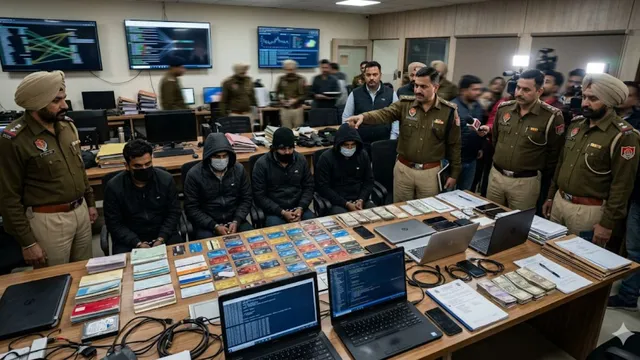
Ludhiana. Interrogation of the 132 accused individuals arrested following raids on two cyber fraud centers located on Ferozepur Road has led to several significant revelations. The bank accounts into which multi-crore transactions from abroad were deposited have been identified as “mule accounts.” The police have so far scrutinized 450 such accounts, through which transactions worth crores of rupees have passed.
The police are now actively engaged in extracting the detailed records of these accounts. Meanwhile, police teams dispatched from Ludhiana to Delhi and Gujarat in connection with this case have arrested four “kingpins” who were operating this fraudulent network. The police will bring them back to Ludhiana for interrogation. It is noteworthy that on May 13, a joint team comprising the Cyber Cell and personnel from two police stations raided the two cyber fraud centers. From these locations, the police arrested 132 accused individuals and recovered cash worth ₹1.07 crore, 229 mobile phones, 98 laptops, and 19 vehicles. The accused used to drain the bank accounts of people in North America and Europe by instilling fear of spam attacks and hacking threats.
Crores Transferred into Rented Accounts
During the initial stages of the investigation, the police identified 300 accounts; however, as the probe progressed, the number of such accounts continued to rise. The total count of these accounts has now reached 450. All these accounts were opened using the identity proofs of various individuals. In exchange for providing their accounts, the individuals lending them were paid a monthly “rental fee” ranging from ₹5,000 to ₹10,000. These accounts were utilized to launder hawala funds and to transfer money obtained through fraudulent activities. These accounts are registered in the names of individuals residing in Punjab, Delhi, Gujarat, Bihar, and Uttar Pradesh. The police are currently focused on thoroughly examining the details of these accounts, as transactions totaling between ₹4 crore and ₹5 crore have already been processed through them. The police are now also conducting an investigation into the account holders themselves.
Renting Office Space Under the Guise of an IT Company
Wherever the accused rented office space, they would claim that they intended to open an IT company—specifically one that operates primarily at night, as their dealings involved foreign clients. Consequently, their office remained open 24 hours a day. Work was conducted here across two to three shifts. Furthermore, they consistently paid a rent amount that exceeded the figure requested by the building owner.
How Are Mule Accounts Used?
An individual is targeted through online fraud—such as fake calls, UPI scams, investment schemes, fraudulent loan apps, OTP scams, etc.
The proceeds from the fraud are not deposited directly into the criminal’s account; instead, they are routed through several different bank accounts.
The money is rapidly transferred onward to prevent the police or banks from tracking its movement.
Ultimately, the funds are either withdrawn in cash or diverted into cryptocurrencies, betting platforms, hawala networks, or similar channels.
What Is a Mule Account?
Mule accounts are bank accounts utilized by cybercriminals to transfer, conceal, or launder funds obtained through theft or fraud. In some instances, the account holder is a willing accomplice; in others, they remain completely unaware that their account is being used to facilitate criminal activity.