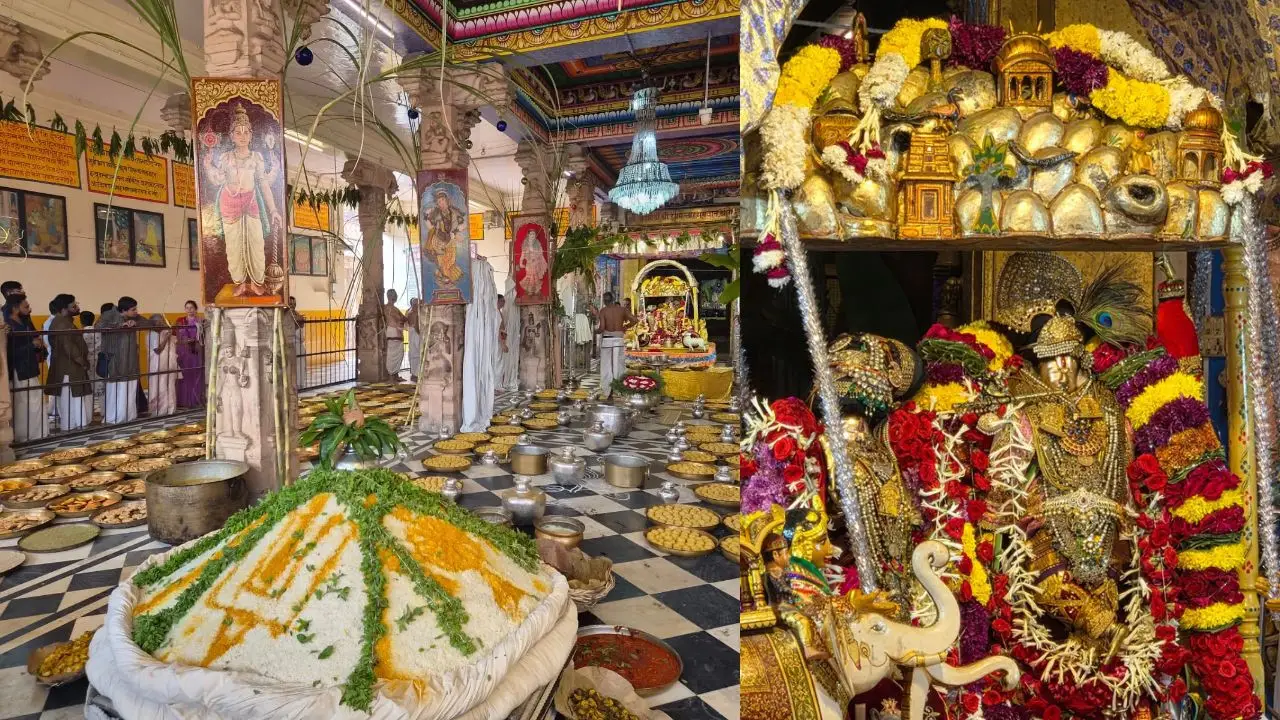
Vrindavan: The grand Annakoot festival was celebrated with devotion and enthusiasm at the famous Shri Ranganath Temple on Saturday, drawing a large number of devotees. On the occasion, Lord Ranganath appeared before worshippers in his Giriraj Dharan form, while a variety of delicacies were offered to Lord Goda Rangamannar.
Devotees began arriving at the temple early in the morning to witness the special celebrations. The temple premises reverberated with chants and devotional slogans praising Lord Ranganath.
Traditional Celebrations at the South Indian-Style Temple
The Shri Ranganath Temple, renowned for its South Indian architectural style, traditionally celebrates Annakoot on the fifth day of the Shukla Paksha in the Hindu month of Kartik. Following this tradition, the temple management organised the festival with religious rituals and ceremonies.
Priests and temple staff had been preparing for the occasion since morning. Around noon, the doors opened for devotees amid the sound of the dhur-gole, prompting worshippers to gather for a glimpse of the deity.
Vedic chants accompanied the prayers and aarti. The rituals were followed by Kumbh Aarti for the deity seated in the Giriraj Dharan form, after which the Annakoot offerings were presented.
Elaborate Food Offerings and Giriraj Maharaj Representation
A wide range of dishes was attractively arranged on gold- and silver-plated trays for the offering. Near the temple’s golden pillar, a representation of Giriraj Maharaj was also created using cow dung.
Temple priest Vijay Mishra said Govardhan Puja and the Annakoot festival hold special religious significance in the Braj region. He explained that Lord Goda Rangamannar is regarded as a form of Radha and Krishna, which is why the festival is celebrated with particular enthusiasm at this temple, despite its South Indian religious traditions.
Mishra added that the temple priests and cooks had spent the previous three days preparing the various dishes for the festival.
Annakoot Prasad Distributed Among Devotees
After the offerings were presented to the deity, the prepared dishes were mixed together and distributed among devotees as prasad. Worshippers received the sacred offering with deep reverence and considered themselves blessed to be part of the celebration.