Kathmandu: Calls to restore Nepal’s status as a Hindu nation are growing stronger once again. The campaign has recently spread beyond the hilly regions to the Madhesh and Terai belts bordering India. Tensions have further escalated after communal clashes in Sunsari district. As a precaution, security agencies have intensified monitoring and security measures along the India-Nepal border.
Why did the movement suddenly gain momentum in Nepal?
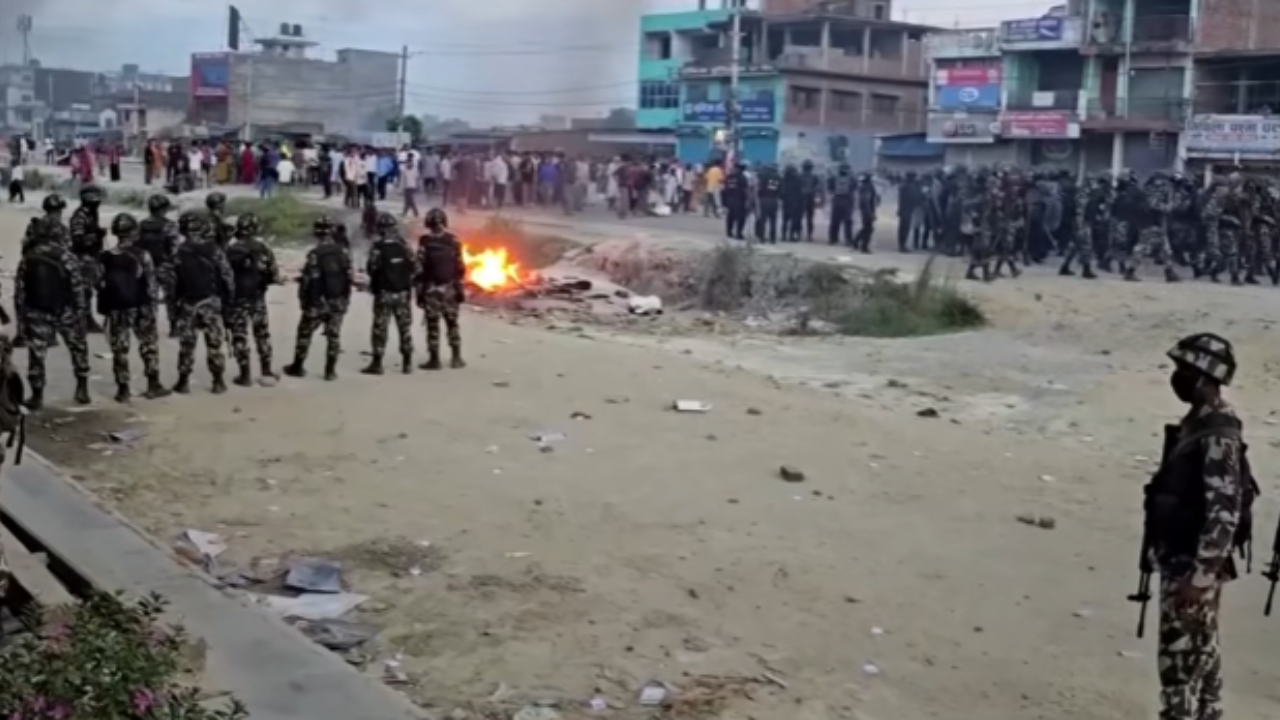
On July 26, a dispute broke out between two communities during a religious procession in the Dewanganj area of the Sunsari district of Nepal. Within no time, the dispute turned into violence, in which three protesters died. After this incident, protests intensified across Nepal, and the demand for Hindu Rashtra once again came into the centre of discussion.
However, the Nepal government has tried to calm the situation. The home minister visited the affected area and met the families of the victims and announced assistance of Rs 10 lakh each to the families of the deceased, but despite this, the protests do not seem to be stopping.
Which organisations have taken the lead in the movement?
More than 15 Hindu organisations of Nepal have united on this issue. These include organisations like Samyukta Hindu Morcha, Hindu Samrat Sena, Rashtriya Prajatantra Party, Mahakal Yuva Shakti and Hindu Yuva Sangh.
These organisations are continuously holding meetings, submitting memorandums and running public relations campaigns regarding 13-point demands. The impact of the movement is also being seen in many border districts including Rupandehi, Nawalparasi, Kapilvastu and Janakpur.
Why has security been increased on the India-Nepal border?
In view of the increasing tension in Nepal, India has strengthened the security arrangements on the border with Uttar Pradesh, Bihar and West Bengal. Sashastra Seema Bal (SSB) and state police have been instructed to maintain round-the-clock surveillance.
According to SSB officials, every person coming and going across the border is being thoroughly investigated so that immediate action can be taken against any kind of suspicious activity.
What steps have been taken in UP and Bihar?
Police surveillance has been increased in the border districts of Uttar Pradesh like Pilibhit, Lakhimpur Kheri, Bahraich, Shravasti, Maharajganj, Balrampur and Siddharthnagar. Intensive checking of people and vehicles is being done at major border posts.
High alert is also in force in Madhubani and Araria districts of Bihar. Biometric verification, face scanning and valid identity card have been made mandatory for those crossing the border here. SSB and local police are also jointly conducting a flag march.
What is the situation in West Bengal and Sikkim?
Additional security forces have been deployed in Panitanki and Mirik border areas of West Bengal. At the same time, surveillance has also been increased at border posts in Sikkim also. Authorities have clarified that no person will be allowed to cross the border without valid documents. Besides, all the vehicles are also being thoroughly checked.
What is the situation at present?
The movement for the demand of Hindu Rashtra is still going on in Nepal. Efforts are being made to negotiate between the government and the agitating organisations, but no concrete solution has emerged so far. On the other hand, India’s security agencies are maintaining full vigil on the border so that any untoward situation can be dealt with in time.