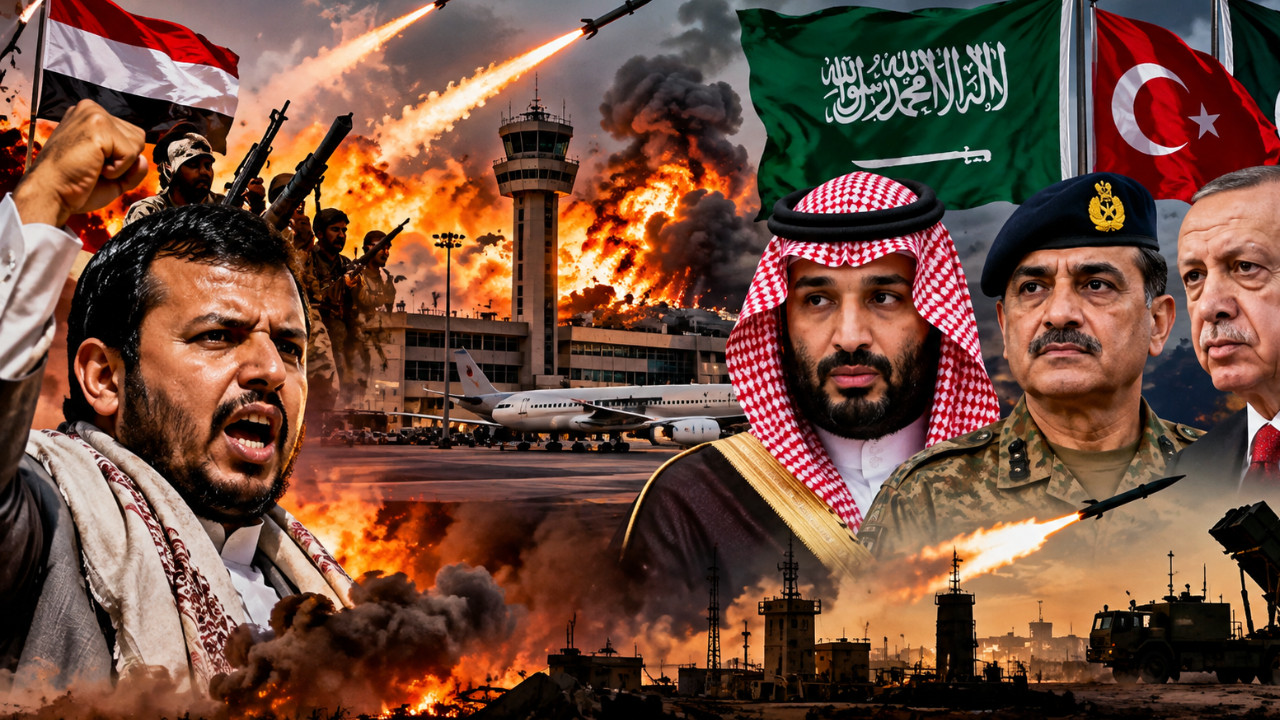
Islamabad: Amidst the increasing military tension in the Middle East, the Mecca Joint Defense Agreement between Saudi Arabia, Pakistan and Turkey is in the news. The three countries have taken steps to increase defense cooperation after Yemen’s Houthi rebels targeted Saudi Arabia’s airports and important targets. However, amid the attacks, the debate has intensified regarding the actual military capability of this alliance and the role of Pakistan.
In August 2026, Saudi Arabia, Pakistan and Turkey signed the Mecca Joint Defense Agreement. Under this agreement, an armed attack on any one member country is considered a matter related to the security of all the members. Following an emergency meeting in Riyadh on October 5, the three countries agreed to implement collective defense commitments and rapidly deploy necessary military capabilities in Saudi Arabia.
Why did attacks on Saudi Arabia’s airports and military bases increase?
The conflict in Yemen between Iran-backed Houthi rebels and the internationally recognized Yemeni government has been going on for a long time. Saudi Arabia has been supporting the Yemeni government. As the conflict has escalated in recent days, the Houthis have claimed missile and drone attacks on key Saudi targets.
The attacks targeted the airports of Riyadh and Abha, killing three people and injuring several others, the Associated Press reported. The Houthis claimed responsibility for some of the attacks, while Saudi officials reported intercepting the missiles and causing damage from their debris.
Are attacks continuing despite Pakistan’s military deployment?
After the activation of the Mecca Defense Agreement, Pakistan and Turkey have agreed to cooperate in the security of Saudi Arabia. However, Pakistan has not made public detailed official details of the total number of its troops and their role.
According to the statement of Pakistan Defense Minister Khawaja Asif, Pakistani and Turkish armies are playing a cooperative role. He said Saudi Arabia’s military is conducting ground military operations, while allied countries are providing reconnaissance and other assistance. Therefore, it would not be correct to say that attacks took place only after the deployment of Pakistani Army or that this deployment was a complete failure.
Will the Mecca Defense Agreement prove effective against the Houthis?
The real test of this agreement is now taking place amidst regional conflict. Saudi Arabia has economic resources and modern defense systems, Pakistan has a large military infrastructure, while Turkey has significant capabilities in the field of defense technology.
But having these resources does not automatically guarantee that attacks will be prevented. Dealing with missile and drone attacks requires intelligence, air defence, mutual coordination and a clear military strategy.
At present it is too early to say whether the Mecca Defense Agreement has succeeded or failed. In the coming days, the actual military role of the three countries, their response to Houthi attacks and the security of Saudi Arabia’s important targets will be important in assessing the effectiveness of this alliance.